
Technology
Dual-stage electrostatic precipitation, engineered in-house for low pressure loss, ozone-free ionisation and easy maintenance.
Why ventilation air needs an ESP
Particles up to 10 µm are inhalable. Many allergens, fungi and bioaerosols sit in the 3–10 µm range, and larger particles can carry viruses and smaller bioaerosols with them.
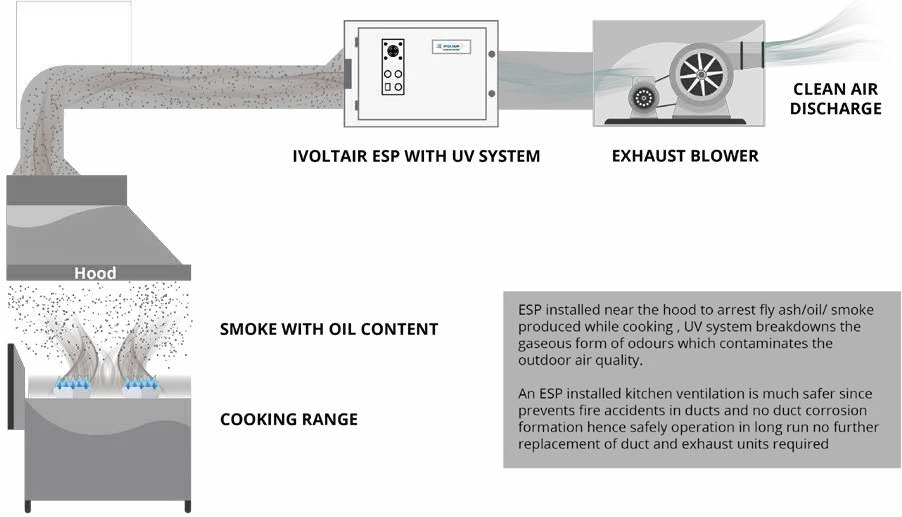
The same particles soil surfaces and equipment. Inside ductwork they feed biological growth and cause corrosion, both of which degrade indoor air quality. In kitchens, grease-laden smoke is also a fire risk in the exhaust duct.
An electrostatic air cleaner removes these particles with far less resistance than a dense mechanical filter, so it protects people and air-handling equipment without a large fan-energy penalty.
How it works
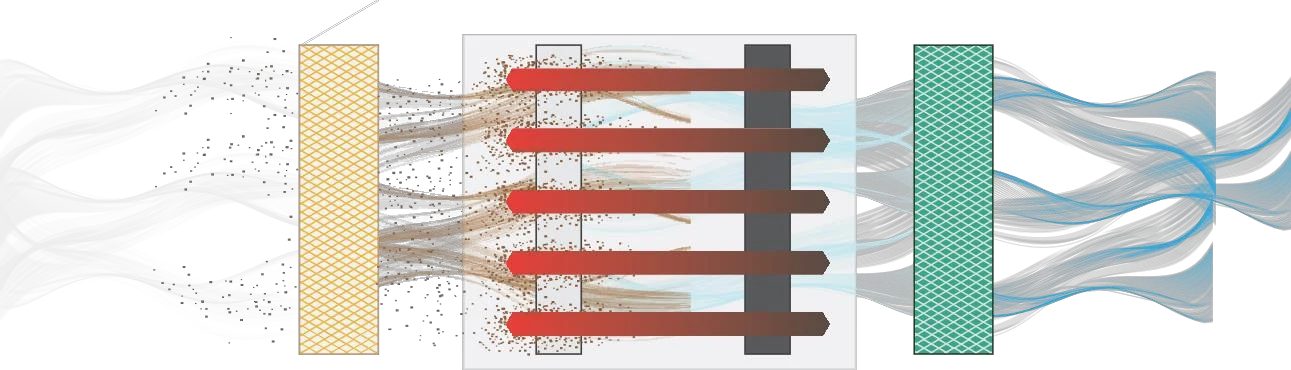
Pre-filter
Washable aluminium mesh in an SS304 frame catches large debris and grease droplets and evens out the airflow.
Ionizer
A high-voltage field from the ZSS® electrode gives every passing particle an electric charge.
Collector
Charged particles are drawn onto precision-spaced collector plates and held there until the cell is washed.
After-filter or UV
Optional UV lamps and activated carbon break down odours and gaseous contaminants.
See it working: live demo
An IVOLTAIR ESP dry scrubber drawing smoke from a cooking pot. With the ESP switched off, smoke comes straight out of the discharge. Switched on, the same smoke is captured in the cell.
- Same unit and smoke source, ESP off and then on
- Watch the discharge on the right of the unit
- Green LED: cell healthy. Red LED: time to clean
Engineering details
ZSS® ozone-free ionizer
An industry-first zigzag semi-spiked electrode, developed by IVOLTAIR R&D, charges particles efficiently while avoiding ozone generation. It does not break or rust.
BDC™ bi-directional configuration
Every IVOLTAIR ESP can be fed from either direction. Installers choose the airflow direction on site, regardless of where ducts and hoods are.
CE-certified PWM power supply
Solid-state dual-output supply with short-circuit and arc protection, recovering automatically within 1.0 second.
Precision collector module
Plate spacing designed for maximum collection, with a mechanically rugged cell that survives repeated washing.
Safety built in
A door safety switch cuts high voltage when the unit is opened, and an earth-leak trip protects against faults.
BMS ready
A no-volt relay reports healthy and maintenance status to building management systems. Ecology units add Modbus RS485 and Ethernet.
Manual clean or auto clean
On manual-clean units, the red LED tells you when the cell needs washing, or you can wash it on a planned schedule. The cell and pre-filters slide out and wash with water and detergent.
Auto-clean units add wash nozzles, a manifold and a pumping system run by a programmable controller. They need a hard wash only once every 4–6 months.
Typical installations
Standards
- ANSI/ASHRAE 52.2-2017 filter efficiency test procedure
- NFPA 96 safety standard for ventilation
- NFPA 79 electrical standard
- CE standard for high-voltage power supply
- IS 2418 for UV lamps (UV models)
- IS 13021 for UV ballast (UV models)
Maximum efficiency is achieved within the specified air velocities and with proper duct design.